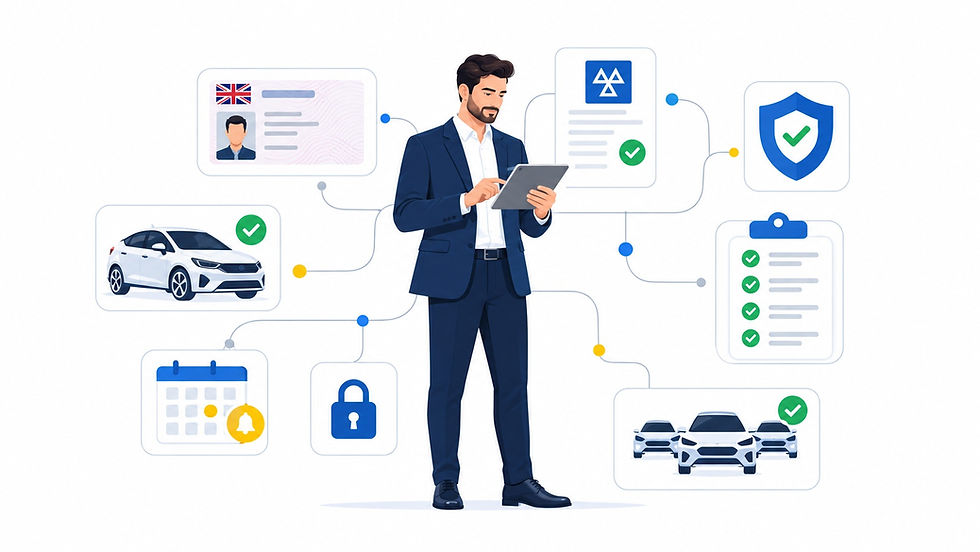
What Is On-Demand Fleet Insurance, and Why Is It Reshaping the Car Rental Insurance Industry?
Oct 25, 2020
10 min read
TL;DR: Fleet insurance is one of the largest cost lines in any rental business, often consuming 30 to 40% of operational costs. Traditional flat-fee policies charge the same premium whether vehicles are running 70% utilisation or sitting idle for half the month. On-demand insurance changes that. Powered by telematics data, it adjusts premiums in real time based on actual vehicle use, driver behaviour and fleet risk, lowering costs and aligning insurance with how the business actually operates.
Insurance is one of the few costs in a rental business that scales with the size of the fleet but rarely with the way the fleet is actually used. A vehicle sitting idle for half the month is charged the same as one that is on hire seven days a week. A van being driven carefully by an experienced operator is charged the same as one being driven aggressively by a new customer. A fleet with strong telematics data and a clean safety record is charged the same as one with no data and no safety story to tell.
For a car rental business where fleet insurance can account for up to 30 to 40% of operational costs, this disconnect is one of the largest hidden inefficiencies on the P&L. On-demand fleet insurance closes that gap. It uses live telematics data, driver behaviour scores and vehicle usage patterns to price insurance dynamically, rather than as a fixed annual premium. The model is no longer theoretical.
According to recent industry analysis, telematics-equipped fleets are securing 15 to 30% premium reductions compared to fleets relying on loss-history-only premium calculations, while traditional fleets are facing double-digit premium increases. The wider market is moving in the same direction. Around 278 million active telematics-based insurance policies are projected for 2026, with the usage-based insurance market growing at a compound annual growth rate of 28.85%, according to FleetRabbit analysis. In the UK specifically, 32.6% of SMEs already have a usage-based commercial vehicle policy, according to GlobalData's 2023 SME Insurance Survey, leaving the remaining two-thirds as both an opportunity for insurers and a risk position for the operators themselves.
For car rental businesses, the implications are practical. On-demand insurance lowers cost, rewards safer fleet management, simplifies claims through automated crash detection and driving data, and provides defensible evidence at renewal. The sections below explain how on-demand insurance works in practice, how telematics data drives the underwriting, and what rental operators need in place to benefit from it.
Coastr’s work on On-demand Insurance helps win Scottish Enterprise’s Smart Innovation Grant
Our in-house data scientists, fresh from their accolade of winning the Scottish Enterprise Innovation Grant, explain how on-demand insurance ensures customers get fair insurance rates. Powered by telematics data, Coastr’s vehicle rental software collects vehicle usage and driving pattern data that determines accurate insurance premiums and in collaboration with insurance providers, gives you access to customised insurance packages instead of a flat fee.

As a car rental business, finding commercial fleet insurance for your vehicles can be an expensive endeavour. The expenses are often as high as 30-40% of your operational costs. This becomes a particularly big problem if you are a small independent car rental business and need to lower your car rental insurance costs. The generic flat-fee insurance offers little flexibility and usually costs more; with the premiums of all vehicles in the fleet being affected if one frequently gets in accidents, or if your fleet is frequently not in use. On-Demand insurance, which is a dynamic fleet insurance can come to your rescue in such a scenario.
Cars are increasingly being integrated with Internet of Things (IoT), telematics technology, like GPS trackers and on-board diagnostics to record a vehicle’s position, speed, vehicle health and other usage statistics, which can be relayed and processed in real time. This data can be analysed by machine learning (ML) algorithms to find patterns in how often and how well vehicles in your fleet are driven. In partnership with insurance companies, this relevant data (as opposed to solely using historical claims data) can assist them to underwrite fleet insurance to be able to offer cheaper and more accurate on-demand fleet insurance.
Having data from previous years improves future risk predictions and data from crash detection and driving patterns helps to automate the claims process.
Benefits of On-demand Insurance
1. Cost-savings: initial investment in these technologies can present long-term benefits, with access to a wealth of data enabling better real-time risk modelling and pricing on insurance. This leads to a cost effective insurance premium, with up to 30% lower costs when fewer cars are in use.
2. Smooth process: after making the switch to dynamic fleet insurance, you’ll start building a database of vehicle usage information, where new data is collected and processed automatically. Having data from previous years improves future risk predictions and data from crash detection and driving patterns helps to automate the claims process. Therefore, reducing the time for repairs and insurance claims to be assessed.
3. Effective competition & revenue growth: by the use of this innovative technology, you can help brand your rental company as forward-looking and help drive customer acquisition and hence revenue growth. This data can also be used to notify users of their driving patterns and thus incentivise them to take better care of the rental vehicles, equipping you with the tools to maintain your fleet in good condition.
The Solution
Car rental companies are always finding ways to reduce insurance costs. At Coastr, we have developed a digital car rental management platform that not only manages bookings, payments, analytics and fleet operations all in one place, but also uses real-time vehicle data collected by telematics (installed in vehicles) to calculate fair insurance premiums. Our data science team is working on a comprehensive set of data to develop an AI enabled on-demand insurance model for insurance companies.
Using this platform, you will not only be able to access vehicle usage statistics but, also see how your fleet insurance can be reduced by applying certain controls in your business. Instead of getting your usual fixed cost insurance which does not account for idle time, on-demand insurance will apply a reduced premium and help lower costs. You can also track individual car users to see how they are affecting the total risk score and thereby your insurance premium. In future, we are also aiming to develop a customer app, that will enable your customers to track their own scores and encourage them to drive better in order to reduce their insurance costs.
Data we look at
We are constantly collecting data that majorly falls into the following categories:
Vehicle information – information held by licensing authorities and car manufacturer information (e.g. engine size, car model, automatic/manual, MOT test records)
Rental companies’ information – branch, location, terms and condition of rentals, services offered
Booking information – types of vehicles, pricing, duration, location, other services, fines, damages, etc.
Customers – frequency of bookings, driving history, usage patterns, choice of cars and preferences, payment methods used, etc.
Telematics data – Driving behaviours, vehicle health, diagnostic code errors, GPS location, speed tracking, crash detection, fuel, idling etc.
The telematics data is without doubt the most useful. This data can be sent from sensors installed in the rental cars to the cloud every ~10 seconds or additionally when triggered by a certain event like pressing the brake pedal. This data can include:
when the engine is on, fuel and emissions data or error fault codes
whether the seatbelt is on during driving
GPS speed, information on if the car is parked or when the brake is applied
location, along with the road type and speed limit on that road
if the vehicle was involved in any untoward incident or accident
How are we building these Artificial intelligence models using Machine Learning?
Step 1: Preparation & Feature Engineering
After collecting the data, it requires some preparation and feature engineering. This includes:
Removing irrelevant data, involving Dimensionality Reduction (reducing the number of features going into our model to only include the essential features for making predictions)
Interpreting textual data (like MOT test results for example) using ML models like Word2Vec which captures the meaning of words and how closely related they are
Filling in missing data (mostly in the DVLA data rather than the telematics) using Univariate or Multivariate Imputation
Converting the data into a normalised numerical format where values are limited to a particular range, so one variable can’t have a disproportionate impact on the model
Step 2: Algorithmic Modelling
Once we have cleaned the data, we split it into a training set and a test set. The training set is used to train the model to find relationships between different factors or predict outcomes. The model can then be applied to the test set to analyse findings.
A Machine Learning model can either be supervised or unsupervised.
There’s also Reinforcement Learning, which is a type of unsupervised learning where a machine trains itself continually using trial and error. In our case, trying to make the best insurance pricing decision as an outcome.
We then need to measure how well our model works at calculating the insurance fee that must be paid. This can be done by:
1. Discrimination: measuring overall performance of the model using AUROC (also known as ROC, C-statistics, or C-index) to look at accuracy, sensitivity (recall), specificity, and precision
2. Calibration: measuring how close the predicted risk score is to the actual probability of an outcome of an accident or a claim made
3. Model Interpretability: how easy it is for a human to understand the decision-making factors of the model. This is especially important in insurance, where you don’t want a black-box algorithm to be making insurance decisions based on irrelevant or discriminatory factors
Step 3: Tuning, Retraining, Viability Tests
Next is tweaking the model using hyper-parameter tuning and cross-validation. Hyper-parameters are variables you manually input into your ML model, like the learning rate for training a neural network, or the k in k-Nearest Neighbours (k-NN). These can be fine-tuned to improve the predictions of the model.
In machine learning, there is commonly a bias-variance trade-off, where models with low bias in parameter estimation have high variance across samples.
Bias: A biased algorithm has a problem of under-fitting, where it cannot make good predictions on the training or the test data due to bad assumptions in the algorithm
Variance: This reflects how well a model can respond to small fluctuations in the training set. High variance can make a model fit to random noise in the training set, leading to overfitting
Ways of resolving this trade-off can be cross-validation, or using bagging or boosting:
Bagging: combining many “strong” (high variance) learners to reduce their overall variance
Boosting: combining many “weak” (high bias) models in an ensemble to reduce overall bias e.g. XG-Boost
Step 4: Results Evaluation & Industrialisation
These results can then be tested on actual customers of car rental businesses. Using feedback from all the stakeholders (customers, rental companies, insurance companies, underwriters who check if risk management criteria are being met), we review our model and make required changes. This model can then be scaled up and used in real-time to dynamically update insurance pricing for customers.
So the next time you ask yourself how to decrease car insurance costs, remember Coastr's AI and telematics powered digital car rental platform, that gives you access to on-demand fleet insurance to do the same.
Follow us on Twitter, Facebook, Instagram and LinkedIn to stay updated on information that could help your car rental business to reduce costs and increase efficiency.